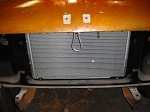
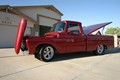
Hello, i am not sure if this is realted or two diffrent problems. I am new to this slick and the forum.
I have a 65 Slick with the 352 with a 4 bl carb. (Think carb is eldebrock) & 3 on the tree.
I have 2 specific questions currentely that maybe someone has seen before:
1. The truck seem to ideal high when in Netrual only. It seems to start well the first time or two in the AM. but after driving it when i start it it turns slow like the battery is alomost dead. right when i get that sick feeling in my stomach it won't start it will start.
2. I really think i may want to change it over to automatic on the floor. What trans, flywheel, etc. would bolt up. New or used. Are there any pros or cons i schould be considering?
could be the usual FE issue with the intake overheating the carb especially if theres no spacer with heater hoses to cool or at least a phenolic spacer.
also timing could be advanced a bit too much.
only auto trans thats a direct bolt up is the c6
welcome from SE Utah
1966 F250 4x4
1964 Rambler Ambassador 990
Rest in peace departed Slick family members
Cam Milam
Lesley Ferguson
Steve Lopes
John Sutton
Thanks, I don't have any heater hoses because someone pulled the heater. would that be part of it? Could I just buy a spacer and put it on between the carb and intake? I think i seen an aftermarket one at my local parts store?
I had the heated manifold on a couple sixes, but never on an eight.
Is there any reason to put one on a 352, or does the spacer do a good enough job?
to the OP, do you have headers? If you do, the header will overheat the starter and cause it to drag. The solution is to install a heat shield, dynamat will work fine.
SO I went out in the cold and took a look again. I noticed that theier are two small wires attached to the coil 1 on each side of the large wire that goes to the distrubutor cap. Any way the red one was loose. I tightened it up and it seem to start better. I did not drive it yet to see how it acts after a bit of running. Do you think that might have been it?
I told you i was new and not to smart on this stuff. LOL
Hi Ron. I have the same prob it sounds like. I was flushing my motor and truck fired up fine first couple times then wouldn't fire after that. It would crank real slow actually slower till it just wouldn't turn. I ran into this before and tightened my new relay. Guess what it wasn't that. Last night in order to finish my flush. I popped my starter and dismantled it. Boy o boy was there a bunch of crud and grease in side. I ended up degreasing with carb cleaner or brake cleaner. Then scotch brighted the copper and the all the metal motor parts. Just shined it all up. My brushes were pretty worn too. When assembling the starter set all the brushes inside in housing where they would be mounted . Put end cap on. Make sure you have a hook of some sort to pull springs back to slip brush in pocket real easy once I figured it out. Conclusion, I need a new starter. I put it in and my truck started right up. Better then ever before. That is what I had to do, not that you need to. I feel the grease build up gets bad over the years and the heat melts grease and disrupts motor operation. Hope this helps.
Start simple and go from there. Clean all grounds going to the motor and elsewhere. Clean all positive connections also, along with making sure things are snug. Don't try overtightening the starter cable. These will strip threads or break off if you get armstrong with a wrench. Starter comes off easily in most cases, and comes apart fairly easily. If, you take it apart, look for starter armature dragging on the fields . This happens when the bushings get worn and is most noticable when the engine is warm, as parts will expand when warmed up. Everything expands but the bushings that is. Since your an armature or novice as you will, this will be an new adventure for you. At worst, you have to buy another starter, at least it's someting you can learn from. One thing to watch for are the washer shims on the armeture shaft by the brushes. These are fiber so that you don't get a short. When you try and remove the end cap these washers will hang up on the brushes. As to grease in a starter, as described , I've seen some nasty stuff come out of a starter but seldom see a lot of grease come out of one, as there is very little grease in one, and I wonder where it might have come from. If, you find evidence of starter drag from badly worn bushings or armature shaft, you can replace the bushings, but not easily done by someone with your skill set. May or may not be neccesary. Just remmember the bushings are fairly cheap, but most likely not easily had localy. Bushings roughly 10$ brushes another 10. A rebuilt starter can be had for 30 to 120 . A used starter 20 to 30$. Check to see if you have a local rebulder, most likely can get done for 30 to 50$. Anyway taking it apart costs little to nothing, and is a learning experience.
Now as to changing transmission, I have three cruisomatics for these trucks. I'm sure at least one of these is in working condition. Do I suggest a Cruisomatic, yes and no. Good transmissions, yes but getting hard to find parts for. I suggest you go with a C6 mainly because of the parts issue. The other and more expensive problem is the shifter for either of these. You need a steering column to fit and these run around 250$ for a good one. You may find one for a 69 to 72 a bit cheaper and this has the advantage that you can get one for power steering. Again, I suggest you start work where needed most for drivability. I don't know if you have addressed my comments on cab mounts, but this is more important than changing transmissions and needs addressing before trying a swap. Spend money and or time where it is needed first. You would be surprised at how much difference it makes in how the standard transmission will shift when everything cab wise is in the right position and stays there.
Rich
1961 F350
1964 Galaxie convertable
1964 flairside, style side, and longbed
1965 Ranger, and shortbed
1966 long bed, and shortbed
A few parts trucks also
1991 Capri
2011 F250
2004 Lexus
Thanks Rich for the reply. Very informative. I noticed my bushing on my armature was warn out too. Causing it to rub on fields, creating gouges on it. My 65 f100 came out of the weeds after sitting for years. Looks like grandpas truck, freak'n awesome. So definate maintenance has and needs to be done. leaky oil pan, valve cover gaskets and exhaust leak also possible rear main seal. let alone all the transmission leaks. Lots of oily slop roaming around down there. Just wanted to say thanks for sheding some light on what I noticed. much appreciated.
Thanks for all the good info. I will take a look at the starter and start checking all the leads & cables o the other parts ASAP.
Today I took it out for about a 20 mile ride (Round Trip) and it seemed to be fine. Then on the way home it started getting dark so I turned on my headlights & I also had my radio going. A few times when I came to a light I put it in neautral and it died out. I had the same problem starting it again.
What was more unusual was that the more I drove the weeker the battery got. I was about 1 block from home and it died and when I tried to start it it was 99% dead and did not start. I went home got my daily driver and jumped it and itstarted right up like nothing was wrong. Also about 2 weeks ago I took the battery in and the auto parts store tested it and said it was in good shape and fully charged. Could it be a timming issuie or the alternator? (It looks Newer)
Does this help to determine if it is the starter or do you think I have another problem?
Rich, I understand and agree and I have checked the cab mounts and they looked very good. They may have been changed. Also the rag joint looked good s well. The problem it the passager core suport. It is rusted pretty good. My buddy is a great welder and he thinks it is something we can fix. Otherwise I seen it at LMC and will buy one.
Need to check alternator output. If output is low, you will need to determine whether it is a regulator, wiring , alternator, or drive belt problem. If output is good, then you will need to check for a heavy drain on the electrical circuit while running. A good battery will "bounce back" from a discharge, but I would beware of the "fully charged" statement, unless it was charged before testing.. I am assuming that you are judging the "weaker battery" by the declining headlamp output. Did you note the ammeter or charge light. The charge light itself may yield little info, but a working ammeter would offer an indication that the charging system was not keeping up with the load. A dependable auto parts can easily load test the battery, starter, and charging system in place. You may find more than one potential problem.
Paul
The Ford Orphanage
Life's too short for boring vehicles!
My quest to develop a universal solvent is held up by the lack of a storage container.
Paul