
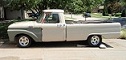
i have a 66 ford f100 with a big block had a 4 speed bull dog in it. took the last couple days (off and on) pulling the tranny to put in an automatic, i had a 65 ford galaxie with a big block and auto tranny, i wanted to put that tranny in my truck well me being a youngen i assumed it would work and other people telling me it would, well you guys not the rest it doesnt work the auto i pulled outta of the galaxie is to long.
[img][img]http://i150.photobucket.com/albums/s116 ... an1035.jpg[/img][/img]
so my question is to the slick gods what do i do??? im wanting to do this as cheap as possible.
So whats my options
-
66rattyford

- Posts: 17
- Joined: April 9, 2007, 7:38 pm
- Contact:

You could just have the driveshaft shortened, got one done here locally for $50. Just call a driveshaft shop and ask them how they want the measurements taken.
1964 F 100 - I am going to do "something" with it.......
viewtopic.php?f=32&t=15942
1987 Mustang LX Convertible, 2.3 Auto - cruiser.
1994 F 150 XLT 2WD
~ Yes - I adopted another cat..............
Cam L Milan,
You'll be missed my friend.
viewtopic.php?f=32&t=15942
1987 Mustang LX Convertible, 2.3 Auto - cruiser.
1994 F 150 XLT 2WD
~ Yes - I adopted another cat..............
Cam L Milan,
You'll be missed my friend.

-
banjopicker66

- Posts: 1488
- Joined: July 17, 2006, 1:59 pm
- Location: Middlesboro, KY
I had the same problem when I replaced the 3 speed with an automatic.
Have the front driveshaft shortened, like Greg mentioned. I did it, and it works just fine.
Follow these steps to get the most accurate length:
Install the transmission onto the engine.
Ensure it is mounted up and bolted into the truck properly, with cross member and all. You can wait to add cooling lines and shift linkage if you want.
Insert the slip yoke into the end of the transmission to its original location. That should be to the wear point, where the yoke was kept clean and smooth by the rear seal.
Have a friend hold up the front driveshaft in position under the truck. (you don't need the rear one for this.) Make sure the carrier bearing retainer is straight with respect to the driveshaft. Or as straight as possible.
Steady the driveshaft next to the yoke.
This is where it can get a bit tricky. Make sure the yoke hasn't moved when you go to make your measurement. Don't move the yoke, either in or out.
Use a crayon (white is best) to mark the center of the yoke's trunnion on the driveshaft.
This is where you are going to point out to the machinist that you want the driveshaft's trunnions centered.
Take the marked front driveshaft and the transmission yoke to a machine shop (or a driveline shop if you can find one.)
Tell the machinist you want the existing driveshaft yoke moved so that the trunnions are in line with the white mark.
Also tell him you would like him to install the required U-joint for both yokes. It s a good chance the yoke for the driveshaft and the transmission are dissimilar. If so , you will require what is known as a conversion joint. A conversion joint allows you to mate dissimilar yokes. It is a lot easier for him to match it up for you there in the shop, instead of you running back and forth to the parts stores several times.
Now you can use the rear driveshaft without modification.
This worked just fine for me.
Two more important thoughts.
First, I highly recommend you replace the carrier bearing while doing this. The carrier bearing and rubber support degrade with time, and you do have a 40 year old truck. By adding an extra U-joint into the driveline geometry, you add a risk of instability. The carrier bearing and support are quite adequate to the task of stabilizing the extra joint, but they need to be in good condition. replace them if you don't know how old they are. The machinist can do this very easily and inexpensively for you as well.
Second, MAKE SURE this is the transmission you want. If you are installing a COM, you have the correct one for that truck. It will be easy to convert the rest of the parts necessary to make it factory correct, such as the steering column and steering linkage. However, if you decide to change to a C-6, you'll have to get another front driveshaft and start over.
Good luck!
Have the front driveshaft shortened, like Greg mentioned. I did it, and it works just fine.
Follow these steps to get the most accurate length:
Install the transmission onto the engine.
Ensure it is mounted up and bolted into the truck properly, with cross member and all. You can wait to add cooling lines and shift linkage if you want.
Insert the slip yoke into the end of the transmission to its original location. That should be to the wear point, where the yoke was kept clean and smooth by the rear seal.
Have a friend hold up the front driveshaft in position under the truck. (you don't need the rear one for this.) Make sure the carrier bearing retainer is straight with respect to the driveshaft. Or as straight as possible.
Steady the driveshaft next to the yoke.
This is where it can get a bit tricky. Make sure the yoke hasn't moved when you go to make your measurement. Don't move the yoke, either in or out.
Use a crayon (white is best) to mark the center of the yoke's trunnion on the driveshaft.
This is where you are going to point out to the machinist that you want the driveshaft's trunnions centered.
Take the marked front driveshaft and the transmission yoke to a machine shop (or a driveline shop if you can find one.)
Tell the machinist you want the existing driveshaft yoke moved so that the trunnions are in line with the white mark.
Also tell him you would like him to install the required U-joint for both yokes. It s a good chance the yoke for the driveshaft and the transmission are dissimilar. If so , you will require what is known as a conversion joint. A conversion joint allows you to mate dissimilar yokes. It is a lot easier for him to match it up for you there in the shop, instead of you running back and forth to the parts stores several times.
Now you can use the rear driveshaft without modification.
This worked just fine for me.
Two more important thoughts.
First, I highly recommend you replace the carrier bearing while doing this. The carrier bearing and rubber support degrade with time, and you do have a 40 year old truck. By adding an extra U-joint into the driveline geometry, you add a risk of instability. The carrier bearing and support are quite adequate to the task of stabilizing the extra joint, but they need to be in good condition. replace them if you don't know how old they are. The machinist can do this very easily and inexpensively for you as well.
Second, MAKE SURE this is the transmission you want. If you are installing a COM, you have the correct one for that truck. It will be easy to convert the rest of the parts necessary to make it factory correct, such as the steering column and steering linkage. However, if you decide to change to a C-6, you'll have to get another front driveshaft and start over.
Good luck!
Last edited by banjopicker66 on June 9, 2007, 6:56 am, edited 1 time in total.
-
banjopicker66
- Posts: 1488
- Joined: July 17, 2006, 1:59 pm
- Location: Middlesboro, KY
A little bit of information about Ford engine terminology.
Ford doesn't use the term "big block." That is a Chevy concept, where they had big and small block engines with the same 350 CID, mostly.
Ford uses the word Family to refer to a type of engine, and you will see the word Series used interchangeably with Family.
Generally, engines at or above 400 CID are considered big blocks. This doesn't work for Ford engines.
The FE (Ford Edsel) family block is almost identical in all applications, and you cannot tell the difference between them easily. You could have a 330, 352, 360, 390, 406, 410, 427 or a 428 - and without tearing the engine down, you couldn't tell the difference. It is all in the bore and stroke, not the external looks. So you can see the term "big block" is not quite applicable.
To make it even more confusing, the 335 series includes the 351C, 351M and the 400 - again, covering both sides of the spectrum.
The 385 series has the 429 and the 460. At least they are well above the 400 mark, but using the series or family term "385" makes it very clear which engine you are referring to.
Hope this helps!
Ford doesn't use the term "big block." That is a Chevy concept, where they had big and small block engines with the same 350 CID, mostly.
Ford uses the word Family to refer to a type of engine, and you will see the word Series used interchangeably with Family.
Generally, engines at or above 400 CID are considered big blocks. This doesn't work for Ford engines.
The FE (Ford Edsel) family block is almost identical in all applications, and you cannot tell the difference between them easily. You could have a 330, 352, 360, 390, 406, 410, 427 or a 428 - and without tearing the engine down, you couldn't tell the difference. It is all in the bore and stroke, not the external looks. So you can see the term "big block" is not quite applicable.
To make it even more confusing, the 335 series includes the 351C, 351M and the 400 - again, covering both sides of the spectrum.
The 385 series has the 429 and the 460. At least they are well above the 400 mark, but using the series or family term "385" makes it very clear which engine you are referring to.
Hope this helps!
Sorta
the 335 family has 2 different trans bolt patterens and deck heights.
If someone were to say they had a 335 familiy engine and wanted to add a C6 you couldn't just say "go for it", you need to know the permutations of that 335 mill.
It is widely accepted by the respective Windsor, FE, 385, 335 forums to use the small, big and mid block disctinctions for clarity. It may be incorret but its so adopted, people who know fords are speaking it as a common language.
These trucks confound me because people heavily modify them without a second thought. I've onle seen 1 FE in a 70 Torino in my life.
Don't even get me thinking about Y blocks or Flatheads. I'm clueless there.
the 335 family has 2 different trans bolt patterens and deck heights.
If someone were to say they had a 335 familiy engine and wanted to add a C6 you couldn't just say "go for it", you need to know the permutations of that 335 mill.
It is widely accepted by the respective Windsor, FE, 385, 335 forums to use the small, big and mid block disctinctions for clarity. It may be incorret but its so adopted, people who know fords are speaking it as a common language.
These trucks confound me because people heavily modify them without a second thought. I've onle seen 1 FE in a 70 Torino in my life.
Don't even get me thinking about Y blocks or Flatheads. I'm clueless there.
Someday I'll get another slick 

-
66rattyford
- Posts: 17
- Joined: April 9, 2007, 7:38 pm
- Contact:


Pretty much any automatic is gonna have a longer overall length than your stick shift. If you can find a '76 or older automatic truck (FE engine) in a boneyard, you should be able to swap the tranny & drivelines from that without much other mods needed...other than maybe differences in u-joint sizes.66rattyford wrote:well its a 352 with a 4sp.
is there anyother trannies i can look for that will work with out shorting the driveshaft.
thanks
j
Just try & pick one that's the same wheel base length as yours.
My "Slickitis" affliction began here...

66 F100 CC/65 F100 CC/66 F250 CC
If it starts to rain, they'll tax the splash.
If you want to fish, they'll tax the bass.
If you plant a yard, they'll tax the grass.
If you don't play nice, they'll fine your *$#!
66 F100 CC/65 F100 CC/66 F250 CC


If it starts to rain, they'll tax the splash.
If you want to fish, they'll tax the bass.
If you plant a yard, they'll tax the grass.
If you don't play nice, they'll fine your *$#!
Shortening the driveshaft really isn't that big of a deal. I cut the carrier bearing support out of the old truck and bolted it in the Uni, set the slip joint, took the measurements, pulled it off and did it again to make sure it was right. Ran the shaft down to the shop he said "see ya in couple hours", ran some errands went back and got it and bolted it in the truck and went for a drive around the block. It took me longer to remove the carrier bearing plate from the 64 frame (lol, that sucked) than it did to do the whole rest of the job. As I said before, cost $50.
1964 F 100 - I am going to do "something" with it.......
viewtopic.php?f=32&t=15942
1987 Mustang LX Convertible, 2.3 Auto - cruiser.
1994 F 150 XLT 2WD
~ Yes - I adopted another cat..............
Cam L Milan,
You'll be missed my friend.
viewtopic.php?f=32&t=15942
1987 Mustang LX Convertible, 2.3 Auto - cruiser.
1994 F 150 XLT 2WD
~ Yes - I adopted another cat..............
Cam L Milan,
You'll be missed my friend.